Home
Blog
Cookout Info

Login/Register

Friends of Sandia Airpark
(an informal website for
for friendly planning &
discussion)

Author: Steve Suddarth

  • You Have Rights in SAEPOA – The Board Cannot Take Them Away

    Last Monday, 17 August, the Board held a meeting.  As usual, they gave very minimal notice about the meeting (less than 2 minutes within the announcement deadline!) and some of us were excluded from the announcement.  The meeting is significant, because the Board took actions that jeopardize our HOA, and our Airpark, and violated your rights.  Here is a list:

    • The Board approved Jerry as the sole negotiator on the lawsuit against SAEPOA seeking its dissolution.
    • The Board ruled that all future votes had to be in writing, and thus meeting motions and votes may no longer be taken.
    • The Board voted for an indemnification policy for itself, essentially setting up a legal fund for themselves personally using your money.

    The first of these actions should deeply concern you.  The last of these actions are clearly illegal (a violation of your rights), and it should be noted that these actions were done in the presence of the Association attorney who is supposed to represent the entire SAEPOA and not just its board.

    Most significant item, Jerry being “voted” to the role of sole negotiator for court-ordered mediation in the dissolution lawsuit.  This action removes any expectation you may have that the Board will be expected to defend you against the plaintiffs who seek dissolution.  In other words, Jerry could negotiate a settlement with the very plaintiffs who want dissolution (arguably his allies), have it entered as a court judgment, and finalize the loss of our HOA before members have any say!  The plaintiffs are all former members of Jerry’s “Working Group” that openly stated the objective of dissolving the HOA.  The main Working Group members who are not plaintiffs are not so because they are board members, including Jerry, who formed the Working Group.  We already know that this Board kept the lawsuit secret for 3 months and then, with minimal notification to SAEPOA members, responded to the lawsuit by urging surrender and immediate dissolution (not a real defense).  We know that the Board, led by Jerry here, is arguing against motions to dismiss the suit.  We should have no expectation that Jerry will defend the interests of the membership of SAEPOA.  The loss of our HOA will be a very significant problem for all lot owners, and the effects will likely linger for many decades — long past when this squabble is forgotten.  It is important that we make sure that Jerry and the Board are aware that they cannot take actions that are not allowed by our Bylaws, Covenants, and Articles of Incorporation.  They cannot seek such actions through court action either.  We must be especially vigilant given that the other two significant actions taken by the board in this meeting (eliminating your vote and giving themselves a legal fund) represent the kind of violation we must prevent.

    Now, let’s turn to the unauthorized and void actions.  I do not use these terms lightly.

    Regarding meeting votes vs. written votes: The Board’s authority comes from the Bylaws, not the other way around.  For the Board to order that Bylaws do not apply would be like the U.S. President ordering that the Constitution does not apply.  Our Bylaws state the following:

    Voting Procedures: Except for annual dues and assessments, which require a two-thirds (2/3) majority, a simple majority of the members present at a meeting will pass a measure.  Balloting by mail will be optional except for special assessments and major document changes. …

    Our Board has flatly decided that our Bylaws do not apply to your voting rights.  This is unfortunately unsurprising since the Board has so far refused to hold any meetings in which members may make motions or hold votes (zero!).  Now they are making it formal.

    Regarding indemnification:  The Board has no authority to indemnify itself against actions by you or anyone else (holding them accountable).  There is no provision in the Articles of Incorporation or Bylaws for this either.  In fact, last year the Board tried to pass a sweeping indemnification provision that members rejected. (This was the subject of the page-long run-on sentence that the Board drafted.)  They know that they do not have the authority to do this.  You should, too.  They should expect to be accountable to the extent that the law specifies, no more, no less. Any other position requires the approval of the membership – you.

    What do you need to do? Come to the dinner meeting this Thursday at 6pm (Suddarth hangar) to discuss this with the neighborhood. 

  • Atty. McDonald’s Opinion on Charity Status – a Good Brief for the Wrong Side!

    Background: For the past two years, our Board has shut down all operations while spending most of our treasury on attorneys. The Board’s reason given for the spending and service denial is that we cannot continue to function (after 30 years) because we hold a charity status with the IRS (under 501(c)(3) of the Internal Revenue Code).  The Board has used this as an argument to dissolve the organization, to liquidate its assets, and to completely rewrite our founding documents, even in ways that have nothing to do with the status.

    Thus, one might think that the Board would have been delighted, if not at least interested in the theory that the charity status was perhaps automatically resolved by what the Board called their “huge win” in court over public status of our roads.  You might think, therefore that we would get immediate feedback and discussion from the email and blog entry about this concept, namely that the “huge win” puts us squarely in compliance with the “black letter” law of the IRS charity definition – resolving our problem (https://kloudcraft.com/blog/2026/07/08/the-dissolution-lawsuit-is-overcome-by-events-it-should-be-dismissed-immediately/

    So, did the Board:

    • Write back to the members about how happy they were that there was a possible path ahead?
    • Reach out the membership and hold a meeting quickly as they had promised?
    • Investigate quickly how to apply the fruits of their “huge win”?
    • Start performing the mission of the organization – such as maintenance and charity?
    • Seek dismissal of the lawsuit against us over 501(c)(3) status?

    Unfortunately, no. The Board spent over a month getting a 60-page opinion from their attorney to reply to the short blog post.  I should characterize Atty. McDonald’s work as high quality, but for the wrong client!  It would be a good brief for our opponents (those seeking our dissolution), but not for his client (us, SAEPOA), and it is incomplete and biased in the way that I would expect our opponents to be — not us!  Our Board and attorney now even filed an objection to a motion to dismiss the case against us.  In other words, our board wants to be sued!

    Because of these things, it is important to address the logic that was given by Atty McDonald, the SAEPOA attorney, supposedly our attorney, quietly posted over a month after the Board was made aware of the benefits of their “huge win”.

    Let’s get into it.

    The Big points: Atty. McDonald’s 60-page document fails to represent our situation properly because:

    1. The arguments against SAEPOA “lessening government burden” fail the
      logic test, and they are also legally incomplete.
    2. Atty. McDonald largely, if not completely, did not address the plain language about maintaining public works.
    3. SAEPOA members should not reasonably expect penalties –  that is a scare tactic.

    Atty. McDonald’s argument is that the IRS will disagree with its own law.  In other words, we can read the plain language Treasury Regulation 501(c)(3)-1(d)(2).

    • Charitable defined. The term charitable is used in section 501(c)(3) in its generally accepted legal sense and is, therefore, not to be construed as limited by the separate enumeration in section 501(c)(3) of other tax-exempt purposes which may fall within the broad outlines of charity as developed by judicial decisions. Such term includes: Relief of the poor and distressed or of the underprivileged; advancement of religion; advancement of education or science; erection or maintenance of public buildings, monuments, or works; lessening of the burdens of Government

    We can clearly see that we comply, but Atty. McDonald claims that the IRS will disagree and interpret the law in their own way – and use that against us.  To do this, he cites 4 IRS rulings (administrative), one tax court case, and one New Mexico supreme court case.  As mentioned, he did a good job of preparing the argument for our opponents, picking cases in which he could make some points.  He did not, however, point out other cases that could support our position.  He also did not look at the flaws in the application of these cases, namely the three points I raise above.

    1. “Lessening of the burdens of Government” is one IRS category of charity.  This is what Atty. McDonald says that we fail to do, and therefore we are not really qualified as a 501(c)(3) organization.  I had highlighted this in my email and Blog post of 8 July.  We now maintain a public road, even under court order.  Nevertheless, Atty. McDonald argues that we fail because:

    • The Town never had the burden previously, so we aren’t “lessening” any burden.  This fails a basic logic test – dissolve the HOA and suddenly the Town will have the burden!  The proper legal test is not whether there was a burden in the past, but rather whether we relieve the Government of a burden that it would otherwise have (we do).
    • Although the roads are public, we are the primary beneficiaries of maintenance – so the benefit is private.  This is an interesting argument because nowhere in the IRS definition does it say what the proper ratio must be (do we have not not benefit at all?)  For example, can I visit a public library if I donate to it? He only has one case where this could be debatable and it is a limited ruling where a block association was ruled to no longer qualify because the public benefit was deemed to be too small.  In another case (not cited by McDonald, even though the reference is in the block association ruling), the IRS held that an association that cared for a small public park that largely served a nearby community could keep its status because it was open to the public.  Sandia Airpark’s roads are indeed open to the public, and the public uses them!  They also serve as taxiways for transiting aircraft.  The stretches of Rainbow Road and Meadowlark Road in the Airpark are also access for non-members.  The community is not gated.  (One of the cases cited by McDonald is for a gated community – thus the reasonable argument that their case [not ours] was really for private benefit only.)  McDonald is asking us to look at ourselves in the most unfavorable light possible, and thus agree with those who seek the destruction of our HOA.
    • He presents a flip-flop position (legal term: judicial estoppel): Atty. McDonald argues that the Town has never accepted responsibility for road maintenance, thus we can’t “lessen” a burden they never accepted.
      This is a strange argument – hear me out.  During the road’s lawsuit, SAEPOA (really the Board and the attorney) cited NMSA 1978 Section 3-20-11 and stated that the roads were public for two reasons:
      – The plat document contained “dedication” language specified to transfer them to the public.
      – The county accepted ownership when it accepted the plat (per the statute)
      They also argued that the Town of Edgewood then owned the roads because all of this territory was transferred during town creation.  What was previously Santa Fe property (and not ours), was now Town of Edgewood property.  SAEPOA is now essentially arguing the opposite of what it just said in court and won.  This is not just improper – it’s actually not allowed legally under a concept called judicial estoppel, which prevents prevailing parties from flip-flopping positions to gain an advantage.
      Regardless, we should take the court at its word.  The Town now owns the roads.  Not “accepting” maintenance responsibility would not really change this.  If SAEPOA is gone, there is presently no one but the Town who would be responsible.
      Finally, the actions of our Board Vice President, Mr. Powers, when he was Town Commissioner also contradict Atty McDonald’s argument about lessening government burden.  Powers led the Commission to vote twice to approve paving a 400 foot section of Rainbow Road in the Airpark.  The fact that the Town backed down (only because of the roads lawsuit litigation) does not change the fact that the Town had accepted a role of maintenance through its decision at that time.

    2. “Maintenance of public buildings, monuments, or works” is largely, if not completely unaddressed by Atty. McDonald’s response.  It’s important to note that we can be covered under either item – “lessening burdens”, or “maintenance of public works”.  Whether you argue that we didn’t lessen the burden because of the past (a poor argument), you cannot argue that we don’t maintain public works:

    • The roads are public – public works
    • Maintaining them is … maintenance.

    This is hard to argue against, so if I were trying to damage SAEPOA, I wouldn’t talk very much about it – and the Board and our attorney didn’t address it directly.  The closest they came was the letter ruling example that involved the block association beautifying their area.  In this case, the ruling against them was primarily because the IRS saw the ratio of public/private benefit as too small, and the area too small (one block).

    It is interesting to note that a counterpoint is given in the very text cited by McDonald. Page 20 includes reference to another case, Revenue Ruling 75-85 where the IRS allowed the exempt status to a similar organization (small organization, maintaining a small public park, but the park was seen as “public” enough).  (I was unable to get the original letter, but discussions of this ruling are available online.)

    This brings up the question of how much private benefit can be allowed? How big does it have to be? Maybe improving the entire superhighway system is good, but improving one block is bad.  Between these two extremes, where is the dividing line? Is our Airpark big enough?  How much is enough good to the general public?  Is providing road/taxi support to a public use airport with visiting aircraft and commercial aircraft services using the roads suitably beneficial? If we wished, we could seek a ruling – something our board and attorney don’t seem to want to do. Nothing about size or relative benefit is spelled out in the law (Internal Revenue Code), but is rather the judgment of the IRS.  In our case, we should not forget that we were awarded the status by the IRS over 30 years ago, and we still operate under that agreement.  Some of us have contacted the IRS informally, and no IRS agen has ever told us that we are in violation.  We meet the “black letter” definition of the law.  We should approach this question from the position that we are compliant and then determine if there is a reason to change – not the other way around.

    3. Penalties from the IRS: To his credit, Atty. McDonald does not attempt any scare tactics regarding penalties, but the Board and allies have often resorted to them to motivate members to modify our governing documents or to dissolve the entire organization.   It is important to note that none of the cases mentioned in McDonald’s analyses discussed penalties, and likely none were involved.  Keep in mind the following:

    • Penalties must survive tax court, and the IRS cannot rule against the IRC and hold up reasonably in court.
    • We have been operating under the IRS determination since 1995.  Although our documents could be read as having multiple purposes ( “exclusive charity” paragraph and an HOA functions paragraph), all of this was present in the documents approved by the IRS.
    • Even if penalties were assessed, reasonably, they could only attach to the treasury, or at most require payment of tax by members who declared deductions (an extremely unlikely scenario).
    • Only board members are subject to scrutiny for misdeeds from the IRS and from a fiduciary standpoint in other legal matters.
    • In this sense, the Board spending our entire treasury on legal fees and none of it on the mission of the organization might arouse scrutiny.

    In Conclusion:

    • The brief from Atty. McDonald paints a worst-case picture, putting SAEPOA in the worst light rather than defending a very reasonable position that we meet IRS guidelines for a bona fide charity.
    • His argument that what we do is not “lessening of the burdens of the Government” is easily countered.  He provides none of those counterarguments, and he completely ignores the logical destination of his argument: if SAEPOA is not there, who other than the Government would be responsible?
    • He does not address the very straightforward language – we provide “maintenance” of “public works”.
    • No penalties were involved in the cases we’re discussing, and that would be expected. If we operate in good faith regarding our status (we do), we should expect no harm from the IRS.

    In short, if we are going to revoke our 501(c)(3) status, we should do it with our eyes wide open as to the consequences and cost.  We should also do something really revolutionary, like actually meet together, it can even include our Board, and not with Zoom and a mute button – but with real people!  The attorney could be there, too, and we could talk with OUR attorney about OUR problems.  Most importantly, we should approach our 30-year-old IRS determination form the position of compliance – not from the position of someone trying to lose.  I invite all to come to the informal meeting after the formal SAEPOA meeting – 7pm, 8/28 Suddarth hangar, 40 Blanco Drive, Edgewood, NM 87015.

  • Your Honor, I Want To Be Sued!

    Most of you know that we are in a law suit with a group of plaintiffs who are seeking to dissolve our HOA, SAEPOA.  The suit is brought by members of what was called the “Working Group” whose other members now include our Board President and Vice President.  It appears that we are expected to live under the fiction that our Board and the attorney they chose (without our required membership approval) is actively defending against the case.

    Recently, their job got a chance to be much easier.  A group of concerned members, I will call them the “5 guys” filed for a motion to dismiss.  The grounds for dismissal are solid, although dismissal motions are always hard because judges really need to be certain – after all, they’re ruling that the case doesn’t even need to be heard.  In this case, the logic is plain.  The grounds for dismissal are twofold: (1) The plaintiffs are suing over IRS compliance, but only the IRS and federal tax court can decide this, not a New Mexico District Court, and (2) no valid reason was given to dissolve SAEPOA, according to the reasons specified in law.

    So, here is a multiple-choice question:

    In response to the motion to dismiss, what did our our board and attorney do?

    a) File a brief in support of this motion to end the lawsuit and stop SAEPOA’s money bleed. 
    b) Stay silent in the hopes that the intervenors would end the case on their own.
    c) File a brief in support of the lawsuit continuing (filed against the motion).
    d) Surrender key arguments to the plaintiffs against us, and even argued their points under the guise of claiming that the lawsuit could be used to “reform” our organization.
    e) c and d above.

    Answer: e

    OK, we all know that on a multiple-choice test the last choice is often the correct one.  It’s true in this case as well!

    That’s right.

    Your board and Atty. McDonald essentially said:

    Your honor, we wish to be sued.
    Please don’t stop the suit.
    We want to continue jeopardizing our organization, and we want to keep spending as we approach insolvency
    … and we would like to provide some rationale to help our opponents kill our organization.

    Let that sink in.

    Come to the informal member meeting at the Suddarth hangar, 7pm, 28 August 2026.

  • Our Board is Driving SAEPOA Straight Toward a Crash

    Those who have been following our Airpark’s management issues saw our Board do the following starting at the beginning of 2025:

    • Stop collecting dues
    • Stop all maintenance activities (claiming that these were “illegal” because we were a charity)
    • Stop all charity activities (claiming that those were “illegal” because we are a maintenance organization)
    • Refuse all Bylaws-required meetings with votes, where we could discuss and vote on remedies to the problem

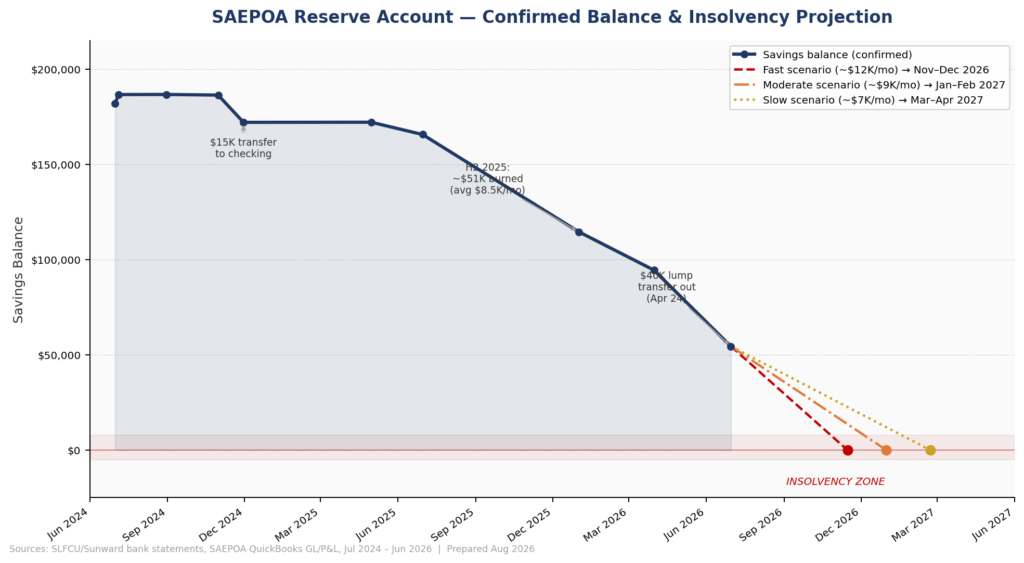
    What you may not know is that this Board has then spent money at an alarming rate.  In fact, they are spending at a rate much faster than any prior board, even though they are doing none of the mission of the organization (by their own admission).

    The problem is so bad, that we should expect to be insolvent sometime between December and April. However, it could be even worse as the Board may be accelerating expenditures, and they also just voted to allow the organization’s remaining funds to be used to cover their own legal defense costs!

    Here is how bad it is – we are crashing – fast:

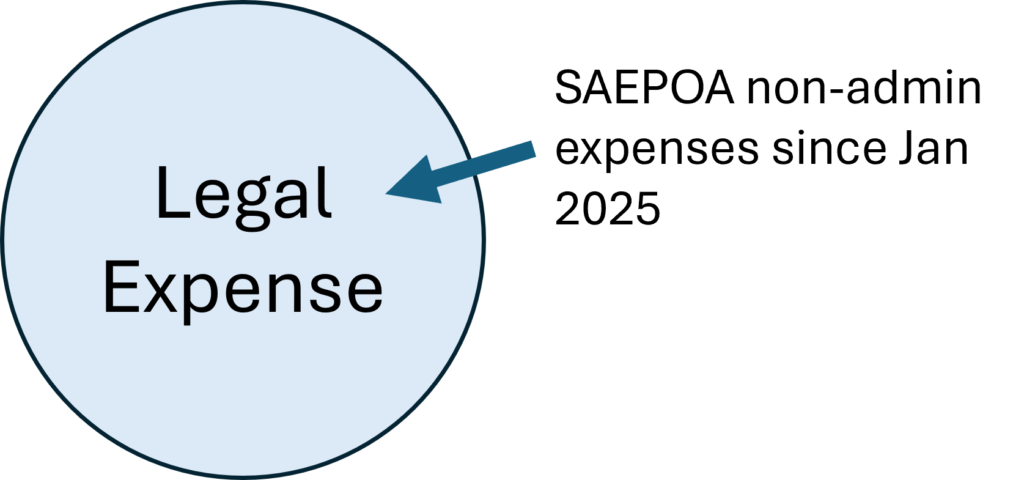
    It’s also informative to see where the money is being spent.  One of the ways to look at non-profit expenditure is to examine the portion of money spent on non-administrative tasks.  Here is a pie chart:

    Indeed, this Board is spending your entire treasury on legal and administrative expenses – not roads maintenance, not community services, and not progress toward a better neighborhood.  You are getting nothing in return.  In a short time, they will have totally destroyed the finances of the organization for which they are responsible – and you get nothing.

  • The Dissolution Lawsuit is Overcome By Events – It Should be Dismissed Immediately

    I’m not an attorney, but I can certainly read and reason about law — and so can you!

    Recently, the Board made you aware of it’s “victory” in court by having our roads declared to not be our roads, but rather that they are now declared to be property of the Town of Edgewood.  Although, at first this appeared to be a hollow victory as the judgment also requires that SAEPOA maintain the roads (and thus saves us no money), there is a silver lining to the judgment.  Namely, that it completely puts to an end the debate over the legality of our 501(c)(3) tax exempt status with the IRS, and thus we should have our Board bring to an immediate end the lawsuit for dissolution (the Ponto et. al. lawsuit), which is based on the clearly disputable argument that we are not properly established as a 501(c)(3) organization.

    This is how our situation has changed:

    • The roads that we previously considered as property of the Association have now been adjudicated as public, and to have been so throughout the life of the Association.
    • Our 501(c)(3) status is based upon paragraphs in both the Restrictive Covenants and Bylaws that state that we are to be operated “exclusively for charitable, religious, education, and scientific purposes, including for such purposes, the making of distributions to organizations that qualify as exempt organizations under section 501(c)(3).”
    • Our founding documents also describe the requirement to maintain the roads.
    • Our current Board has argued that these two are in conflict with each other (i.e., we can’t do charity because we need to do HOA work, and we can’t do HOA work because we are a charity).
    • The Board also claims that we cannot do any HOA work (maintain roads) because it does not qualify as “charitable and public benefit”.  We had debated this point before.
    • HOWEVER, now the roads are public.  By definition of the Internal Revenue Code, maintaining the roads — that are now public — fits squarely within the black-letter language of the law.  The roads are supported as charitable under “erection or maintenance of public buildings, monuments, or works”, as well as “lessening the burdens of government”.
    • The specific passage is in Treasury Regulation § 1.501(c)(3)-1(d)(2) and is shown below with the important sections highlighted.
    • Thus, Treasury Regulation § 1.501(c)(3)-1(d)(2) makes it clear that maintaining the roads is CHARITABLE work according to the IRS, no different from hosting Young Eagles or putting on a Santa Fly-In, or teaching classes.  All of our work is charity!
    • The argument over 501(c)(3) status is now moot.  There is no credible argument that we do not qualify as an exempt organization.
    •  Since “charity” includes both the activities we do (such as Santa Fly-In) and the maintenance activities, there is no conflict.
    • The judge ruled that SAEPOA be responsible for maintenance of the roads.
      • ¶49: “Pursuant to the three Plats, the Association is required to maintain the roads within the Airpark.”
      • ¶63-64: The roads are public and owned by the Town; the Association is responsible for maintenance.
      • ¶27: No public funds have ever been used to maintain the roads. SAEPOA has been subsidizing Town infrastructure entirely.
    • Thus, the Board must restart operations immediately and end this ridiculous embargo of providing services.
    • The Ponto (dissolution) lawsuit’s claims were completely eliminated by the recent judgment because the basis of the lawsuit is the claim that the HOA must be dissolved for reasons that are clearly negated according this judgment.  Since the roads are public property, there is no legal basis for the Ponto lawsuit.
    • Our association attorney should immediately file for the Ponto lawsuit to be dismissed.
    • The Ponto plaintiffs could perform a service to their neighbors by simply withdrawing the lawsuit.

    We can then get back to operating as an airpark neighborhood.

    Here is relevant “black-letter” text of the Internal Revenue Code (Treasury Regulation § 1.501(c)(3)-1(d)(2)):

    Charitable defined. The term charitable is used in section 501(c)(3) in its generally accepted legal sense and is, therefore, not to be construed as limited by the separate enumeration in section 501(c)(3) of other tax-exempt purposes which may fall within the broad outlines of charity as developed by judicial decisions. Such term includes: Relief of the poor and distressed or of the underprivileged; advancement of religion; advancement of education or science; erection or maintenance of public buildings, monuments, or works; lessening of the burdens of Government; and promotion of social welfare by organizations designed to accomplish any of the above purposes, or

    (i) to lessen neighborhood tensions;

    (ii) to eliminate prejudice and discrimination;

    (iii) to defend human and civil rights secured by law; or

    (iv) to combat community deterioration and juvenile delinquency. The fact that an organization which is organized and operated for the relief of indigent persons may receive voluntary contributions from the persons intended to be relieved will not necessarily prevent such organization from being exempt as an organization organized and operated exclusively for charitable purposes. The fact that an organization, in carrying out its primary purpose, advocates social or civic changes or presents opinion on controversial issues with the intention of molding public opinion or creating public sentiment to an acceptance of its views does not preclude such organization from qualifying under section 501(c)(3) so long as it is not an action organization of any one of the types described in paragraph (c)(3) of this section.

  • Uncle Sam Fly-In

    Your local EAA Chapter 1306 hosted the 2nd Fourth of July Sandia Airpark Fly-In last Saturday.  We had a great time, had good food, good fellowship, and we discovered the Uncle Sam (a.k.a. Daniel Berger) flies a helicopter!  We hope to continue to host this event, along with the Santa Fly-In every year.  It’s great fun for the flyers, the neighbors, and anyone from the overall community who can join. What a great celebration!  250 years of the greatest nation!

    When you get a chance, please give a special thank you to John Lorenz, Chris Wilson, and Mark Campbell for the special role they each played in leading the volunteers and supporters!

  • The Crux of the “Roads” Lawsuit

    1. The SAEPOA board and its supporters claim that we do not own our roads, but rather they are property of someone else, namely they claim that the roads are property of the Town, and thus the Town could pay for their maintenance on their behalf (not likely according to town commissioner responsible for road management). 
    2. A group of residents, including Jeff Berg, claim that our roads belong to us, the lot owners in Sandia Airpark through our representative organization, SAEPOA.  They seek “quiet title”, where a judge clarifies the ownership.  Because the Board has involved many in its attempt to change ownership, the lawsuit is against SAEPOA (because of the Board’s actions), the Town (because they were the attempted recipient of the roads, during a time when Board member Jerry Powers was also a town commissioner), and Ken White (a former lot owner, and son of the developer from 30 years ago, who suddenly and curiously in 2023 claimed to have given his rights of “ownership” of our roads to the Town).

    What follows is my quick summary of the arguments Deborah and I saw from a review of public documents regarding the case. We are not parties to the case, and so we only have limited visibility. There may be portions we missed from depositions or outside documents not easily available from the county clerk.

    The Plaintiffs’ Argument

    The plaintiffs (your concerned neighbors) point to numerous documents that make ownership clear:

    • 1979 Subdivision Plat for our developement (called “Rainbow Hill” at the time): “Access to Private Property Gated”
    • 1986 Plat of Sandia Airpark (Phase I): “All roads shown hereon will be maintained by the Homeowners Association”
    • 1987 Plat of Sandia Airpark (2X for Phase II & Phase III): “All roads shown hereon will be maintained by the Homeowners Association”
    • 1993: Our founding documents defined our common areas to include “all roads in the residential area, including the north/south portion of Rainbow Road (from the runway property boundary to the Airpark entrance)”
    • 1994 A Santa Fe Land Use Associate Planner stated: ” The roads/taxiways within the Sandia Airpar Estates subdivision located in Edgewood, Santa Fe County New Mexico, are owned and maintained by the Homeowners Association of the Subdivision”
    • 1997 Master Plan Amendment for property records: “All roads/taxiways shown hereon are and will be maintined by the Homeowners Association”
    • 1998 Plat for “Vacation of Easement” granted title (ownership) for portions of Rainbow Road to the commercial owners to the West of Sandia Airpark residential areas.
    • 2013 Plat of Copage’s area in the commercial area includes a description of a 60′ right-of-way “maintained by Sandia Airpark”

    Finally, over the history of the Airpark, no corporate action (such as a proper [or even improper] vote) was taken to give away our property rights regarding the roads.

    The Board’s Counter Argument

    The core of the Board’s argument comes from a single statement on the 1986 plat:

    The property shown is surveyed, platted and subdivided and comprises Lots 1 through 35 inclusive, together with the streets and thoroughfares of Sandia Airpark Estates East, with the free consent of and in accordance with the wishes and desires of the undersigned owners and proprietors thereof: to the public forever [empasis added – by the Board’s attorney], said owners do hereby dedicate the easements shown on this plat, including the rights of ingress and egress and the right to trim interfering trees.  This subdivision lies within the planning and platting jurisdiction of the County of Santa Fe, New Mexico.

    Note that the Board and it’s allies, attorneys, etc. are quick to point out the words “public forever”, but omit to say WHAT is “dedicated” to the public forever, namely what was given was an EASEMENT, not ownership!

    Similar words are also quoted by the Board’s attorneys in the PLAT OF SURVEY.

    The streets and thoroughfares within Sandia Airpark Estates East properties are dedicated to the use of the public forever by the subdivision plat field for Santa Fe County…

    Again, the attorneys seem to be claiming the USE is equivalent to ownership — it is not.

    Well, that’s about it, except for the complications mentioned below.

    Complications

    Given how thin the Board’s argument is, it’s not surprising that their legal approach is to complicate the matter.  They have argued the following, much of which has already failed (been dismissed or not responded to by the judge).

    Lack of valid reasons to sue:  The Board’s attorneys claim that the plaintiffs “lack standing”, that they are “not harmed” if the Town takes ownership, and even that they are essentially not allowed to sue because they are members of the Association!

    Statute of Limitations: The Board’s attorneys argue that the plaintiffs can’t sue because of a 3-year statute of limitations, claiming that the 3 years would apply to the 1986 plat, not the current actions of the Board! (A case could be made, in fact, that the 3-year statute of limitations means that the roads are indeed property of SAEPOA. After all here we are with a board arguing exactly 40 years after-the-fact (!) that a phrase in the plat transfers ownership–even though that phrase doesn’t really say it.)

    Ownership vs Maintenance: The Board claims that documents specifying our obligation to maintain the roads does not mean that the Town does not own them.  While true, there is no clear evidence that the Town does indeed own the roads.

    The Town polices our streets:  Indeed, and the Town polices the Walmart parking lot, but it does not make the parking lot Town property.

    The Town has a responsibility for safety:  While true, it does not confer ownership.  The town has a responsibility to stop crime on your front lawn as well.

    Regular stream of motions to dismiss or summary judgment against the plaintiffs: Our Board is using your money (SAEPOA funds) for quite a bit of legal process, several motions for dismissal of the suit and for summary judgment — all dismissed by the judge.

    Depositions: The most recent documentation regards a motion for discovery that began with the plaintiffs complaining that, even though they’ve received voluminous documentation, that they have not recieved the documents they sought from our Board (sound familiar?).  This resulted in a motion to compel depositions from the Board.  The Board sought depositions, then from several plaintiffs.  It’s clear that this is a very expensive and ongoing process — it’s costing all of us a lot.  Those of us outside the process have no idea what has been said or done with the depositions.

    The deed from Ken White: I’m a bit unclear on this one, but from the best I can tell, Ken White, heir to the original developer of Sandia Airpark (Walter White, who has not owned the Airpark for over 30 years) filed a deed in 2023 claiming that IF he owned our roads, that he has now given them to the Town.  It is interesting timing, given that this is when our key Board member, while he was commissioner, attempted to take the roads and to pave Rainbow Road at Town expense.  We know of no clear documentation of Ken White’s ownership of our roads.

    What SHOULD Happen

    Your board should serve you, the resident.  The road would be simple and not costly.  Rather than attempting to tranfer our roads to the Town without our consent, the Board should invite the members to meetings to discuss (IN PERSON!).  We should weigh whether we wish to deed our roads to the Town and we should find out if the Town is willing to accept them.  Should there be a clear will to do so, we should take a proper written 2/3 majority vote for the action.

    Had our board respected our rights, it would have saved a lot of pain and expense for the Association as well as the plaintiffs.  The Board could resolve this immediately if it wished.

    Essentially, we are victims of behind-the-scenes political action in which we, the residents, were not invited on issues of great consequence.  The purpose of the suit by our neighbors is to protect us from losing our rights.

  • Our Board May Have Placed Our Roads In Jeopardy

    The second significant agenda item our board has named for their upcoming SAEPOA Zoom meeting is “Update on Legal Matters/Lawsuits”.  To date, the Board has been active in two lawsuits.

    1. The lawsuit submitted by Ponto et al. (also known as the “dissolution” lawsuit), that suspiciously sues the Board to force the very things the Board sought to do itself, namely to dissolve the Association.  Unsurprisingly, there has been no action on that lawsuit since June of last year, as if it no longer mattered once the Board lost its attempt to dissolve the HOA.

    2. The lawsuit submitted by Berg et al., also known as the “roads” lawsuit.  This suit simply confirms our ownership of our property, the roads, and seeks “quiet title”, where a judge has made this fact clear.  The suit has been shrouded in mystery for those who are not either among the plaintiffs, or among the Board (or perhaps its close allies).  It is perhaps the most significant item of business we have in the Airpark right now.  I believe it accounts for much of the Board action that we have had difficulty understanding.

    Because the Berg et al. (“roads”) lawsuit is so important, Deborah and I did a search through public records in Santa Fe to get information we are not getting from our Board.  I will attempt to provide my best interpretation ofwhat has happened so far.  Understand, however, that I am not an attorney, I am not a participant in the suit, I have not participated in any depositions, meetings, or deliberations, and thus my knowledge is imperfect.  However, since the Board has shared nearly nothing over the past two years about this suit, I must make some attempt to educate all of us as to what is happening and what is at stake.

    Why this matters:

    A bad misstep in handling our roads could result in significant cost to each lot owner.  We could also have great difficulty ever getting the roads repaired.  Worse, we could conceivably lose our right to taxi if we lose ownership of the roads — essentially destroying our community as an airpark and greatly harming everyone’s real estate value.

    In short, you run the following risks:

    • As shown in our companion post at https://kloudcraft.com/blog/2026/01/29/the-crux-of-the-roads-lawsuit/, the legal argument for public ownership is very weak.
    • Transfer of roads to the public could jeopardize our right to taxi.
    • Costs and expenses are very unclear.
    • It is unclear if the Town of Edgewood would accept the roads.
    • Any guarantees given for the right to taxi by the Town could be reversed by government action if we no longer own the roads.
    • Finally, and perhaps most importantly, the Board is denying your rights as a lot owner to have a voice in what happens with your roads.  This is a decision that rightfully should involve deliberation among the lot owners and proper voting with a required 66 lot majority.
    • The Board has usurped your right to participate in the decision by attempting a “fait accompli” through political action.

    In fact, the “roads” lawsuit has only one purpose, to put the brakes on the political action engaged in by our Board and restore (1) a proper condition of who owns the roads (us), and as a consequence (2) to allow the lot owners to make their own proper decisions, per our governing documents, to handle our own roads.

    If you want some good background, don’t get it from me, rather get it from the article in NM News when the suit was filed at:

    https://nm.news/2024/07/26/neighbors-sue-over-edgewoods-plan-to-taxi-aircraft-on-public-road-2/

  • Removing 501(c)(3) Status Need Not Be Complex


    The first of two significant topics in the upcoming (1/30/26) SAEPOA meeting is “Discussion, Questions and Answers on Remaining Options to Correct Governing Document Conflicts With IRS Rules and Regulations and HOA Purpose”.

    Last Fall, our board attempted to completely rewrite our rules to give themselves unchecked power as the solution to revising our documents to resolve the 501(c)(3) status, when a total rewrite was not necessary.  Rather, simple changes will make it possible.

    Curiously, On December 15, I was asked for input by one member of the Board regarding what such a minimal input would be.  I replied on December 17 with the information below.  I got no reply until 22 January, but I was shown a set of documents revised in the manner I recommended.  In the same email, I was asked for a dialog, but there was no follow-up from my response email.

    Thus, we don’t know if the Board is going to take this input into account or not.

    It would be very helpful if the Board would communicate prior to meetings.

    The changes are even simpler than they appear below.  Most of the writeup shown is to indicate what portions of the documents can simply be removed.


    Minimal Approach to Scrubbing SAEPOA Governance of 501(c)(3)
    References

    The following suggestions would make it possible to remove
    our references to the status and dispel any question as to our requirement to hold the status or to hamper the function of the Association that functioned properly for over 30 years, even with the documents as they currently read.  We should be able to revoke the 501(c)(3) status at any time.

    My research on the subject has also shown no evidence that we would have to return money or any other drastic actions as part of the process.

    Bylaws:

    This is very easy.  We simply remove the two paragraphs from the 2018 Bylaws that make reference to the status in Section I and Section VIII as follows:

    I. PURPOSE: The general purpose of these Bylaws and of this corporation is to manage the common areas of Sandia Airpark Estate and to enhance and further the enjoyment of the property owners in the use of the common areas and facilities, as well as their own properties. Enforcement of the rights of the association against any member violating the Restrictive Covenants shall be considered a duty of the corporation.

    (PORTION STRUCK OUT)The Association is organized exclusively for charitable, religious, education, and scientific purposes, including for such purposes, the making of distributions to organizations that qualify as exempt organizations under section 501(c)(3) of the Internal Revenue Code, or the corresponding section of any future federal tax code.

    VIII. ADDITIONAL POWERS OF THE ASSOCIATION: The SAEPOA shall have the right to

    1) Make rules and regulations concerning speed limits, parking, trespassing, and pollution;

    2) Limit and regulate the size, type, subject matter, location, and elimination of signs within the property;

    3) Provide guard service;

    4) Limit and control access to Sandia Airpark Estates, including the right to prohibit access at various locations and hours, and to require identification permits for access to the property;

    5) Regulate the use of the common areas and any facilities in the common areas, to charge fees for the use of such facilities, and to make regulations concerning the conduct of persons within the properties;

    6) Make any rules or regulations as deemed necessary to promote recreation, health, safety, welfare and protection of the residents, property, and environment.

    (PORTION STRUCK OUT) No part of the net earnings of the Association shall inure to the benefit of, or be distributable to its members, trustees, officers, or other private persons, except that the Association shall be authorized and empowered to pay reasonable compensation for services rendered and to make payments and distributions in the furtherance of the purposes set forth in the article. No substantial part of the activities of the Association shall be the carrying on of propaganda, or otherwise attempting to influence legislation, and the Association shall not
    participate in, or intervene in (including the publishing or distributing of statements) any political campaign on behalf of or in opposition to any candidate for public office. Notwithstanding any other provision of these articles, the Association shall not carry on any other activities not permitted to be carried on (a) by a corporation exempt from federal income tax under the section 501(c)(3) of the Internal Revenue Code, or the corresponding section of any future federal tax code, or (b) by a corporation, contributions to which are deductible under section 170(c)(2) of the Internal Revenue Code, or the corresponding section of any future federal tax code.

     The Association may acquire (by gift, purchase, or other means), own, hold, improve, build upon, operate, maintain, convey, sell, lease, transfer, dedicate for public use or otherwise dispose of real or personal property in connection with the affairs of the Association.

    Articles of Incorporation:

    These are also simple, but not simply by striking text.  The offending paragraphs are both found in
    the “Purpose” section of the document as highlighted below:

    PURPOSE AND POWERS OF THE ASSOCIATION

    (PORTION STRUCK OUT) The Association is organized exclusively for, charitable, religious, education, and scientific purposes, including, for such purposes, the making of distributions
    to organizations that qualify as exempt organizations under section 501(c) (1) of the Internal ‘Revenue Code, or the corresponding section of any future federal tax code.

    A. The Association may fix, levy, collect and enforce payment by any lawful means, all charges or assessments pursuant to the terms of the Declaration of Covenants; to pay all expenses in connection therewith and all, office and other expenses incident to the conduct of the business of the Association, including all licenses, taxes or governmental, charges levied or imposed against; the property of the Association.

    B. (PORTION STRUCK OUT) No part of the net earnings of the Association shall inure to the benefit of, or be distributable to its members, trustees, officers, or other private persons, except that the Association shall be authorized and empowered to pay reasonable compensation for services rendered and to make payments and distributions in furtherance of the purposes set forth in Article Third hereof. No substantial part of the activities of the Association shall be the carrying on of propaganda, or otherwise attempting to influence legislation, and the Association shall not participate in, or intervene in (including the publishing or distribution of statements) any political campaign, on behalf of or in opposition to any candidate for public office. Notwithstanding any other provision
    of these articles, the Association shall not carry on any other activities not permitted to be carried on (a) by a corporation exempt from federal income tax under the section 501. (c) (3) of the Internal Revenue Code, or the corresponding section of any future federal tax code, or (b by a corporation,
    contributions to which are deductible under section 170(c) (2) of the Internal. Revenue Code, or the corresponding section of any future federal tax code.

    The Association may acquire (by gift, purchase or otherwise), own, hold, improve, build upon, operate, maintain, convey, sell, lease, transfer, dedicate for public use or otherwise dispose of real or personal property in connection with the affairs of the Association.

    Here are some options going forward:

    1)     Replace the entire Section with the Section from the prior version.

    a.     The prior version can also be simplified greatly
    to include just the first and last paragraphs.

    2) Remove paragraph B of the 1995 Articles and replace the opening paragraph with the following text pulled from the prior version.  Thus, the new document would read as follows (new part in red):

    PURPOSE AND POWERS OF THE ASSOCIATION

    This Association does not contemplate pecuniary gain or profit to the members thereof, and the specific purposes for which it is formed are to provide for maintenance, preservation and architectural control of the residence Lots and Common Area within that certain tract of real
    property described as:

    Sandia Area Estates East as shown and described on the plat thereof filed in the Office of the County Clerk of Santa Fe County, New Mexico on the 18th day of February, 1987, in Plat Book 171, pages 010 and 011 under Reception No. 615,127,  (description should be
    verified)

    The Association may fix, levy, collect and enforce payment by any lawful means, all charges or assessments pursuant to the terms of the Declaration of Covenants; to pay all expenses in connection therewith and all, office and other expenses incident to the conduct of the business of the Association, including all licenses, taxes or governmental, charges levied or imposed against; the property of the Association.

    The Association may acquire (by gift, purchase or otherwise), own, hold, improve, build upon, operate, maintain, convey, sell, lease, transfer, dedicate for public use or otherwise dispose of real or personal property in connection with the affairs of the Association.

  • Advice To Members For Filling Out Your Ballot

    The upcoming vote is a very important one and it could greatly affect the value of your property. Our Board is now seeking another two years of total control, as well as very hasty approval of an entire new set of governing documents with almost no opportunity for the members to make a proper review and input.

    After receiving and looking over the new ballot, we noticed a few things:

    1. The Board has once again added the codes at the bottom of the ballot, indicating a level of distrust of the members — at least to the level of “trust but verify”
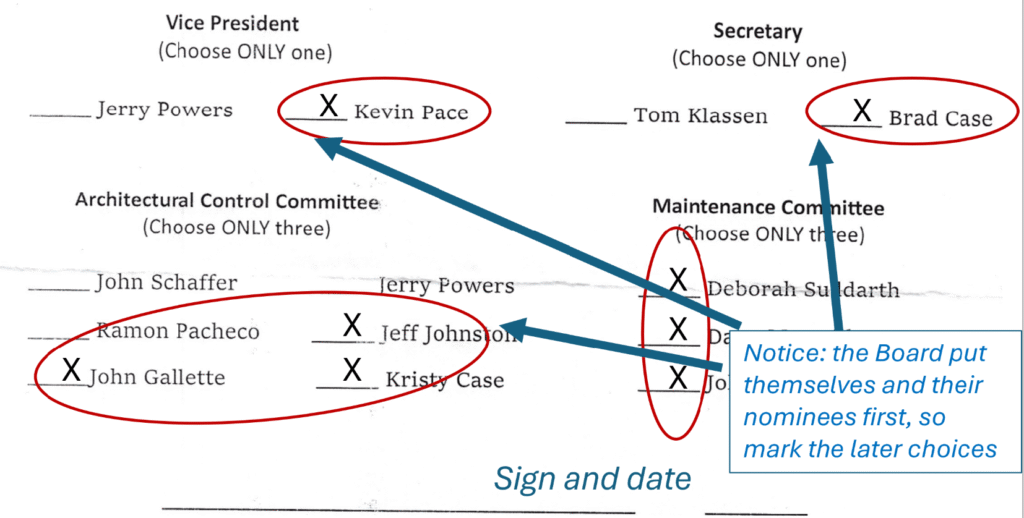
    2. The Board placed themselves and their chosen candidates first on every list. There are studies that show that this can confer an advantage, sometimes a substantial one.
    3. We see no provision for member involvement beyond that of the Board from the time you mail your ballot until they are counted in the meeting. (In other words, your ballot could get lost, and you would not have any way of knowing if/how/where this happened.)
    4. The “Ballot question” page does not specify in clear legal terms what set of governing documents are being approved. (i.e., no versioning, titles, dates, revision numbers or any clear identification of the documents is given). In addition to the process being very hasty, it might be possible for the Board to make modifications from the documents shared up to this point.

    Therefore, we wanted to provide the following advice to help make the process straightforward, and to provide you with a level of confidence that we can “trust but verify” the actions of the Board as well.

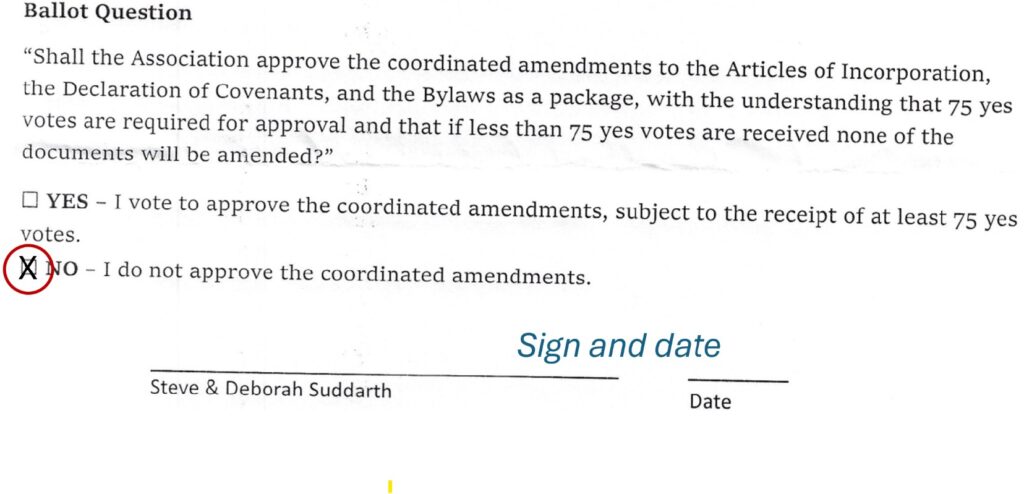
    1. Fill out the ballots in the manner shown below.
    2. Ensure that we have knowledge of your vote so that we can verify the process. Doing one (or both) of the items below can help greatly:
      • Scan, or take a cellphone photo of your filled out ballot and share it with one of the following people:
        • Steve Suddarth, director@transparentsky.com, (505) 803-2684
        • John Lorenz, john@fracturestudies.com
        • Kelly Tanis, dukecitydatsunclub@outlook.com
      • Hand-carry your ballot to the meeting (although you then need to make sure you will be there on time).

    Here is how to fill out the ballot:

    • Page 1 of Ballot – choosing candidates
    • Page 2 of Ballot – Governing documents

  • We Don’t Need New Rules — We Need a New Board

    At the very last minute, our board decided to push a surprise change to all of our founding documents, including a massive change in your voice (to reduce it), and a change to their power (to increase it).

    The Rules Don’t Matter To This Board

    Meetings and Voting: The best way to understand how someone will operate under new rules, we need to look at how well they operate under the existing rules.  Our current board has completely failed at this.  They demonstrated this during their most recent board meeting where our Vice President stridently stated that quarterly meetings and member voting were suspended because, in the Board’s words, the tax problem was serious enough to preclude all other activity.  According to them, we couldn’t hold meetings or votes until they resolved the issue to their own satisfaction.  Thus, the Board selectively chose to deprive all members their votes — even their meetings — based upon their own declaration of a sort of organizational “state of emergency”.  Given what is in the new documents (removing quarterly meetings, and removing most items on which we previously voted), the Board has signalled that it never had interest in member participation anyway.

    However, the quarterly meetings, including motions and voting, are a requirement, and not just when the Board decides to allow it.

    Required Approval of Contracts: The Board authorized itself substantial expenditures on lawyers, at least $15,000.  According to our Bylaws, all contracts must meet two requirements: (1) to be selected by the President, and (2) to be approved by the SAEPOA (membership).  The Board chose to disregard this requirement.  When challenged, the board VP stated that such approval was not needed, because the mere election of the board members sufficed for them to act on behalf of the organization — again a complete disregard for our governance.  Again, the Board has signaled its disrespect for the membership in their proposed restated documents, in which the membership would only have a voice for contracts of over $50,000!  This is an insane amount, as we have not issued a contract that large in the last 20 years.  In fact, the proposed $50K contract level is about the same as an entire year’s receipts for the Association!

    Getting member approval of contracts is a requirement — not to be disregarded.

    Unilateral Change To Governance: In January, we members had to listen in as the Board chose to roll back governance to 1995.  (They have since modified that stance — but only in part.)  Their logic was the prior voting policy was “illegal” according to themselves and selected lawyers opinions (NOT a judgement or a member vote).  Thus, without any member voting, they simply reversed things (dues, governance) with no voice whatsoever to the membership!  Furthermore, we can find no record of legal filings of their changes with Santa Fe County (also a strict legal requirement).

    Such actions require proper voting or judgments!

    General Courtesy and Duties:  In a recent board meeting, a member asked for clarification about an overdue request for readily available financial records.  Timeliness matters because of the election.  The Board balked at the tardiness, said that it was busy, and would get the document at a future time that the board would not specify.  According to NM HOA statute (Section 47-16-5D), SAEPOA owes the member $50/day for failure to comply with required a 10-day timeline.  When the member reminded the Board of the state law, the Board indicated disinterest and challenged the member to sue the HOA to get any fine paid.  Challenging a member to sue for a simple issue of regulatory compliance is striking.  Why not simply comply with state law and provide the documents?

    Before our board expects members to approve a total change of our governing documents, this board must first show that it can govern according to the existing rules. 

  • The Board Made a Few Changes To Their Proposed Documents – But Not The Ones Most Needed

    On Thursday, 9 October, our Board held another one of their Zoom-only board meetings (“mute button” and all) to discuss inputs and change to the proposed documents (Restrictive Covenants, Articles of Incorporation, and Bylaws).  Although the meeting covered some topics beyond the proposed changes, in this blog entry, we’ll focus on the changes themselves.

    The Board assumed that all changes were folded into my written input that they have shared with the membership as a whole.  Unfortunately, this is not the case, and other members have also shared many items.

    For the most part, the suggested changes were dismissed, but the following changes were proposed, and you should expect new wording from the Board in the near future.  Furthermore, the Board made it clear that they intend to still vote on the revised documents at the meeting in about 2 weeks.  In my opinion, this is incredibly hasty, but they intend to go forward anyway.

    Although the documents were edited in several places, the actual changes to content are few because there are several repeated sections and references within and between the documents.  Here are the changes that they decided to make.  They will possibly make others in the revision that they promised to release:

    1. The board struck the entire “indemnification” section that we have talked about many times (very confusing, convoluted, and clearly absolving the Board of all legal responsibility, no matter what).

    2. The Board added language to clarify that an affirmative vote of 66 lots would be required to dissolve (similar to our existing documents, but ignored by the Board in the May attempt to dissolve).

    3.  The Board agreed to require member votes to transact real property, adding paid staff, and to issue contracts, but only for contracts of greater than $50,000 value (thus this will likely never be voted on).  In all of these cases, the affirmated 51 vote requirement is added (please see the blog here to see why these votes will be difficult).  The difficulty of the votes will likely not matter, however, as it is very unlikely that any such votes will be taken (more on that later).

    4. Some caveat words were added for a contract between SAEPOA and Sandia Airpark, Inc., regarding the restoration of payments for runway access.

    5. Language was added to allow for special assessments.

    6. The Board added language in the Restrictive Covenants to require hangars on all new construction projects.  There was as a new addition, and so final language is probably still in draft.

    In my opinion, although the documents were modified, they still are too risky, and they take away too many of your rights.  Most notably, provisions were not added for quarterly meetings, and the Board signaled no interest in ever resuming in-person meetings for all but those most essential (such as annual meetings or their prior attempt at dissolution).

  • 51 Votes is a Trap

    Join me in a thought experiment. 

    A Hypothetical New U.S. Constitution

    Imagine that we had a U.S. President who suggested that our current U.S. Constitution was not properly ratified because it was only signed by white men.  Furthermore, we had allowed slavery in our earlier days.  Therefore, all Federal Law is “illegal”, and we need to reverse all law. (By the way, this is an actual position taken by Elie Mystal, a commentator on MSNBC, C-SPAN, and PBS.  He refers to the Constitution as “actual trash”, and claims that all laws passed before the 1965 Voting Rights Act should be viewed as invalid.  In some sense, he claims that we either need to “dissolve” or at least “deconstruct/reconstruct” the USA.)

    Now, imagine if this President suggested a “fix” to this “problem”:

    1. A whole new constitution and set of federal laws will be written.

    2. We’ll start with the President’s draft, which he wrote in secret, and we’ll ratify it at the end of the month.

    3. The President’s new constitution addresses a few popular topics that have languished, such as providing better protection for kids against child predators.  So, the President pushes the benefits of having benefits (like fewer child predators).

    4. The President’s constitution, however, also has the following provisions:

    a) It will abolish the House and Senate, because decisions will be “steamlined” through the executive branch.

    b) It provides for no debate or discussion with the government outside of “special” activities called by the government.

    c) It will provide total immunity and “advance pardons” in perpetuity for all senior executive officials, and anyone they designate.

    d) It will provide a very simple check on executive power through popular vote. (Let’s talk more!)

    About Our Hypothetical U.S. President’s Popular Vote:

    Imagine that the President said that the people could reverse any decision he or his cabinet made “simply” by showing that a majority of Americans actively voted against it in a special referendum.  Sounds simple.  We just trust the President and his cabinet to do everything properly, and if we disagree, we just vote him down.  Well, consider this:

    – The hypothetical President did not refer to a majority of those voting, but rather a majority of all 262 million Americans eligible to vote, so you would need over 131 million votes to negate his action.

    (As a reference, the highly contested 2024 presidential election had a total of 155 million votes cast.  131 million votes would be a nearly 85% majority of that total number of votes.)

    – Further, imagine that this new constitution made no provision for how the special election takes place.  Perhaps when public outrage grew to where over 131 million could possibly vote down an action, the President and the cabinet would simply not call for the election, and would not allow for the provision of the election to be arranged by the public.  It’s possible that a legal fight might result in the referendum, but the process would be very difficult and very long.

    – The actions of the President would be executed with the stroke of a pen (like executive orders), but would require the above process to be negated, which might take months or years.  In the interim, the new law would be in full effect.

    – If the public is greatly harmed by the arbitrary actions of the President or his cabinet, the people would need to remember that all senior officials have absolute immunity.

    – In the unlikely even that the public actually won a “veto” vote, the President could just sign another decree to work around it.

    How is This Analogous to SAEPOA’s “Restated” Founding Documents?

    But wait!  You might ask how can you say that our small HOA is analogous to this hypothetical U.S. constitutional proposal?  Surely we can just veto board actions with the 51 votes as stated.

    Well, it won’t work.

    Consider that in our Airpark, 51 vote majorities are extremely rare.  Most votes have little participation.  Sometimes majorites are around 20 votes.  Recently, we’ve seen these numbers get larger, but only because things are more hotly contested/polarized.  (In other words, high voter participation is often a sign that there are serious problems.)

    Consider the 52 “yes” votes for dissolution that the Board loves to cite as evidence of the popularity of their move to dissolve our association.  Aside from mentioning that many people vote for things for many reasons, the Board also doesn’t mention all of the resources it put into tipping the scales in their favor:

    – Extensive selling of the dissolution resolution using the authority of the Board, including 4 meetings, a video and many emails.

    – Controlled member interaction through Zoom and the “mute” button.

    – A strange lawsuit to push the vote.

    – A direct mailing using authoritative statements from the Board telling the members how they needed to vote.

    – Another mailing (ironically) from the plaintiffs suing the Board telling members they needed join with the Board and vote for dissolution.  (We received our the same day — with eerily similar language between the two mailings.)

    – Proxies that were designed to push votes in favor of dissolution.

    – Of the two votes that were contested as questionable, the Board decided (without pre-stated criteria) to count 1 vote in their favor, and to not count 1 vote in their opposition.

    Even with all of these advantages, the Board failed to get the required 66 votes.  But more importantly, with the Board’s finger heavily on the scale, after spending 5 months of effort, they only got to 52 votes.

    How can we members reasonably expect we will reasonably organize the process in an HOA that no longer has meetings, raise 51 votes, and follow up with enforcement.  We will likely have to fight the Board even to have the votes taken and we enjoy none of the advantages the Board used in its push for dissolution.

    The proposed 51-member vote is similar to how impeachment in the U.S. constitution provides a false reassurance that the U.S. can get rid of bad public servants, but in fact impeachment doesn’t work.  (In the entire 249-year history of our country, no official, other than 8 judges, have been removed through impeachment.)

    In short, the Board knows that their 51-vote process would likely never succeed with a veto action.  No other check is placed on board power in their new documents.

    The Board will rule unchecked if you accept this.

  • There is a Much Simpler Fix For Our Governance Documents

    The Board has proposed a very complex set of new documents to define our Association.  After a detailed review of these documents, they appear to only do three things:

    • They remove references to being a charity and thus could be used to change our IRS status and remove a potential (but unproven) problem with IRS compliance.
    • These documents remove the Board’s accountability to you, the member, and give the Board nearly unlimited power unchecked by the members.
    • The documents muddle the relationship among the covenants (CCRs), Articles of Incorporation (AoI), and Bylaws, making them difficult to maintain in the future.

    This complex set of documents, 24 pages in all, represent a massive, confusing, and unnecessary change to our governance, and it only partially addresses the “IRS problem” because, although it modifies the documents, it does not take direct action to modify our IRS status.

    A much simpler option is possible by placing the following proposal for a vote by the membership.

    • Simply amend the existing Bylaws, removing all references to charity and stating the purpose as that of an HOA.
    • Rescind the status with the IRS at the same time.  (The Board must actually contact the IRS!)

    This change would even be simpler to pass, requiring only 66 signed votes, as opposed to 75 for the document change proposed by the Board.

    Here is a sample proposal:

    SAEPOA proposes the following action to modify official purpose of the organization from a charity to a pure HOA: (1) modification of Bylaws as stated below, (2) authorization of the Board to rescind our IRS 501(c)(3) status.

    1. Modification of Bylaws:

    Remove the second paragraph of Section I, which currently reads as follows:

    The Association is organized exclusively for charitable, religious, education, and scientific purposes, including for such purposes, the making of distributions to organizations that qualify as exempt organizations under section 501(c)(3) of Internal Revenue Code, or corresponding section of any future federal tax code.

    1. Authorization of Removal of IRS Tax Exempt Status

    The SAEPOA Board of Directors is hereby authorized to rescind the organization’s 501(c)(3) status and operate as an HOA under the amended Restrictive Covenants, Articles of Incorporation, and Bylaws.


    ___________ FOR proposed change – i.e., rescind SAEPOA IRS tax exempt status

    ___________ AGAINST proposed change – i.e., keep SAEPOA IRS tax exempt status


    Member(s) __________________              Lot(s) ________________

  • Do the Proposed Governance Documents Fix Anything? – Unfortunately Not

    Friday, October 3, the Board released their proposed changes to the restrictive covenants (CCRs), Articles of Incorporation (AoI), and Bylaws.  The Board presented this as an example that they were, in fact, taking action, perhaps a response to my prior email and blog posts about the promises the Board has made but not kept.

    We were not given any of these documents in advance of the Board meeting, and we were informed of them with no prior discussion.  The Board, however, plans to vote on these new documents at the upcoming annual meeting, a mere 26 days from now.

    When asked for comment from the Board, I stated that I was “cautiously optimistic,” which I meant sincerely.  I reviewed the documents from that perspective despite these concerns:

    • Why now? – at the end of 2 years of this board’s inaction, just before an election.
    • Why was there no involvement or even prior discussion with the membership? – regarding all documents that define the Association.
    • Why were these documents developed “tabula rasa”? (without history)
    • The documents appear to originate from some template or example. What was it?
    • Who drafted the documents? (A particular board member? An attorney?)
    • Why are the documents locked so you can’t copy text from them?

    Unfortunately, the documents are much worse than I hoped.  See below:

    Here are some details:

    CCRs:

    The best of the collection is the set of restrictive covenants.  I only say this, because the document appears that it would do no harm, if it were properly modified to remove the sections that are erroneous and repetitive relative to the other documents.

    That said, the document also appears to do no good as well.  In other words, if we passed the CCR changes and nothing else, we would change nothing of any substance as opposed to simply leaving the existing CCRs in place.  There is no compelling reason for this change, and unnecessary document changes introduce unnecessary legal risk.

    The primary errors in these documents are found in Section II (Governance) and, to a lesser extent, Section VI (Architectural Control Committee and Maintenance Committee).

    • Section II largely contains prose that is repeated in the Articles of Incorporation. It describes in considerable detail about the SAEPOA board composition, election processes, even dates and schedules.  Most of these details are proper for the Bylaws and not the AoI or the CCRs.  Placing these details in the CCRs could make future modification very difficult.  It could also create conflict due to the repetitive nature – if one document is changed, the other must be as well.
      • Typically, CCRs do not contain any detail about property management associations – they are attached to the property, and thus are associated with restrictions on the land use.
      • Our existing CCRs are much better in this regard, only containing 2 references to the SAEPOA. One reference is just to define the term.  The other notifies lot owners that they are automatically, and of necessity, included as members in SAEPOA.
    • Section VI contains details about our two formal committees (architecture and maintenance). These details are more appropriate for the organizational documents (AoI and/or Bylaws), but they may be included here because the Board is still hoping to dissolve the Association, and therefore it may hope that these two committees continue as standalone entities.  We should reject this notion for multiple reasons – namely that this case would involve two “disembodied” committees without a reasonable method of election, enforceability, management, etc.

    Most importantly, although these CCRs were developed from scratch, I could not see anything that would change of any substance.  There were a few minor points, like a restriction of 3 aircraft per lot (why?), but I could not find any reason to change our current CCRs to these.

    I gave them a grade of “C+/B-” because they were unnecessary, but relatively harmless if the repetitive portions were cleaned up.

    Articles of Incorporation (AoI):

    The Articles are much more problematic.  They need more than just a cleanup of repetitive text, specifically, they contain changes that are harmful, or potentially harmful to the Association and the members.  The changes to the Articles also contain nothing of benefit (solve no major problems for the association).

    • Harmful – Article IX (Indemnification) is one of the most convoluted legalese paragraphs ever written.  For example, let me show you just the first sentence:

      “Each person who was or is made a party or is threatened to be made a party to or is involved in any action, suit, or proceeding, whether civil, criminal, administrative, or investigative (hereinafter, a “proceeding”), by reason of the fact that he or she, or a person of whom he or she is the legal representative, is or was a director or officer of the corporation or while a director or officer of the corporation is or was serving at the request of the corporation as a director, officer, partner, trustee, employee, or agent of another corporation or of a partnership, joint venture, trust, or other incorporated or unincorporated enterprise, whether the basis of such proceeding is alleged action or inaction in an official capacity as a director, officer, partner, trustee, employee, or agent or in any other capacity while serving as a director, officer, partner, trustee, employee, or agent shall be indemnified and held harmless by the corporation to the fullest extent authorized by the New Mexico Nonprofit Corporation Act as the same exists or may hereafter be amended (but, in the case of any such amendment, only to the extent that such amendment permits the corporation to provide broader indemnification rights than said law permitted the corporation to provide prior to such amendment), against all expense, liability, and loss (including attorneys’ fees, judgments, fines, taxes, or penalties and amounts paid or to be paid in settlement) reasonably incurred or suffered by such person in connection therewith and such indemnification shall continue as to a person who has ceased to be a director or officer and shall inure to the benefit of his or her heirs, executors, and administrators; provided, however, that the corporation shall indemnify any such person seeking indemnification in connection with a proceeding (or a part thereof) initiated by such person only if such proceeding (or part thereof) was authorized by the Board of Directors of the corporation.”

    • Article IX appears to say that board members are to be completely protected from any misdeeds. They already enjoy considerable protections via the corporate veil and protections from legal malfeasance when done with attorney advice, if in good faith.  Why is this page-long gobbledygook needed?  Could it cause harm?
    • Harmful – Article X (Dissolution) removed the prior protection against hasty dissolution, requiring 66 signed votes. Given that this board tried to dissolve the Association, and it ignored this provision, this change could lay the groundwork for another attempt by the Board.  Is the Board signaling another dissolution attempt?
    • Harmful — Article VI and Article VIII establish 51 vote thresholds for several actions (removing a board member, reversing a board decision, sanction an errant member).  On the surface, this appears to be a check on board power, but it is a much more difficult standard to reach a conclusion than our current requirement of a simple majority vote in a meeting.  Furthermore, the restated documents require a special meeting for such votes, and the document does not state that the members can call the meeting, and thus it is very likely that these provisions could never be exercised.  
    • Article VI (Director/Officers) is largely repetitive to Section II of the CCRs. Very confusing.  It’s even more confusing because this section would normally belong in the Bylaws.
    • Finally, Article XI (Effective Date) specifies how the Board plans to pass the new document. Current Articles (which would apply) require a signed vote by 75% of the members (75 lots must approve!).  This paragraph, however, simply says that the new measure would be passed by a vote of a quorum of 75% of the members.  Is the Board expecting to get away with passing this with a simple majority in a meeting of 75 attendees/proxies?  If so, it runs afoul of multiple guidelines that are must stricter.  This is perhaps an oversight, but there appear to be several major oversights.

    Again, there are no major problems solved by the proposed Articles.  There is no reason to take the risk of adding these bad provisions and bad writing.

    I gave this document a grade of “D” because it’s not acceptable, even with simple cleanups.  It would need substantial revision to avoid harm.  Even then, it adds no value to the Association.  Just stay with what we have – it’s cleaner and provides better protection.

    Bylaws:

    Frankly, the proposed Bylaws would be a disaster for the Association.  The proposed changes would formalize the Board’s tyranny over you, the members of the Association, and you would lose your voice as a member.

    Traditionally, SAEPOA members have enjoyed many rights and opportunities to rectify situations.  Jerry Powers illustrated this well when he moved for a vote during a meeting to ensure that the runway corporation be paid, despite board reticence to pay the due bill.  Jerry’s motion was seconded, and a vote was held requiring the Board to honor its obligation to pay the debt and we were kept in the clear again.

    Now, we have a board that does not respect our current Bylaws that require such meetings, motions and votes.  Our Board, largely run by Jerry, does not allow the same rights that he used to pay the bills.  (And this board has, in fact, not paid the bill, causing a compounding financial problem.)

    The proposed Bylaws changes would formalize the Board’s current disregard for member participation in governance.  Your voice would be reduced to simply being allowed to vote for officers once per year, in an election process also completely run by the Board.

    Let’s take a closer look at the problems:

    • Repetition (again!) – Article IV (Director/Officers) opens with the same repetitive prose that is also largely in the CCRs and the Articles! Again, any changes would require changing all 3 documents!
    • No quarterly meetings – The word “quarterly” does not appear anywhere in this document, because these Bylaws clearly eliminate quarterly meetings! However the quarterly meetings were your guarantee that you have a voice and an ability to repair damage from any improper board actions/inactions.  Perhaps this is why the current board is not holding any quarterly meetings in violation of the current Bylaws.
    • Provision for “special meetings” (4.4) – The proposed bylaws make allowance for “special” meetings. We have seen what is meant, because so far every meeting called by our current board has been deemed as “special”.  “Special” has come to mean that members cannot make motions or take votes.  In fact, all year, this board has only allowed one vote – their failed attempt to dissolve the Association.
    • Electronic meetings (4.5) – This section states that board meetings will provide for electronic means of connecting. Although this is not harmful, and perhaps helpful, we now know that this board has taken the view that meetings should not be held in-person, and it appears to be a means of squashing dissent.  Although it’s fine for meetings to offer electronic presence, we need a requirement that the meetings be held in-person even more.  These two are not mutually exclusive.
    • One of the most disturbing sections is the bizarre “Manifestation of Dissent” (4.6). Our current board campaigned on ending “automatic yes” votes that had already ended years ago.  Now, they have reintroduced a strange “automatic yes” vote within the Board, in which any dissenting member must be extremely clear on their dissent, make sure the dissent is in the minutes, or dissent promptly via registered mail.  Otherwise, they are automatically counted as having given their agreement with what the board leadership has proposed.  So even board members are being stifled if they disagree!
    • These proposed Bylaws specifically prohibit the creation of any committees outside of architecture and maintenance (Section 4.10), perhaps to ensure that members can’t request committees to do things like address governance or nominations.
    • No restrictions are placed on the President regarding authority to make contracts or otherwise bind the Association. The prior restraint requiring a member vote is gone in this new document.  We know that the current board ignores the requirement in the Bylaws for such approval.  These Bylaws would formalize it, and you will have no ability to register any dissent or restraint as a member.
    • Article VI (Contracts, Loans, Checks, and Deposits) – Makes it even more clear that the Board is the sole entity with a role in any major decisions. All checks/balances from before are removed, and the Board can go as rogue as it wishes.
    • The Bylaws conclude with the same confusing statement about approval with a quorum at a meeting, rather than the required 66 votes.
  • No, Mr. Middleton — Proper Meetings are Not Happening

    In a recent email, I was accused by Mr. Brent Middleton of “gaslighting” regarding a number of issues, including my statements that the Board has not held proper quarterly meetings and that the Board has denied the members acceptable means of feedback.  These characterizations don’t match reality, however, and the mismatch affects you as a lot owner, as it jeopardizes the decision-making process and thus could have serious consequences on the value of your investment.  It’s also not a great way to run an organization.

    Quarterly Meetings:  The board member’s email stated:

    “the board HAS conducted ALL required quarterly meetings and has had MORE ATTENDANCE and PARTICIPATION than any other board due to the Zoom meeting option.”

    Well, unfortunately, it’s just not so.  Has this board held meetings with the membership? Yes, in their own controlled and restrictive way.  Has this board held quarterly meetings?  Absolutely not.

    Quarterly meetings are for membership participation, which most importantly includes the ability of members to vote on business that requires membership votes (like approving contracts with attorneys).  Quarterly meetings also allow the general membership to make motions for topics to be discussed and voted on.  Over the past year, the Board has held no such meetings – not once.

    Every meeting held by the Board this year has either been a formal board meeting, or a “special” member meeting, meaning that the Board has specifically disallowed motions, votes, or open discussion periods.  For the most part, communication has been one-way (more on that later).

    Participation:  Brent said:

    “We ALWAYS allow comments and questions, in fact WE ALLOWED YOU, STEVE, 20-30 MINUTES ON A ZOOM CALL IN SPITE OF A 3 MINUTE COMMENT LIMIT! So when you come off with “they are not transparent and censoring us” you are far from being truthful.”

    There’s a lot to unpack here.  First, the comment periods are indeed limited.  One exception was cited above, namely the meeting on 14 May in which I was “allowed” (to use their words) 20-30 minutes in a back-and-forth discussion regarding the dissolution vote this board had scheduled for a mere 8 days hence.  The board actually began the meeting asking me to speak in this manner (interestingly with no prior notice), but this was because I was representing a large group of lot owners who had previously participated in two of our Town Hall meetings to discuss the same topic.  In other words, the Board specifically stated that they were suspending their 3-minute limit specifically for that one exception.  No other members were afforded this opportunity, and this was a one-time opportunity.  Brent is aware of this.

    Now that we’ve established that there was the single exception above for comments, let’s talk about what is normal.  Normally, the meetings only have a Q&A period at the end complete with microphone muting on the participants using Zoom.  In other words, we are now running our meetings for an HOA with only 99 lots like it was a city of some magnitude.  Meetings typically have fewer than 40 actual people participating (even with Zoom), so we’re saying that this small number of people needs to be regulated to timed Q&A periods.  In most cases, each participant is given only one time slot, and there is no back-and-forth.  The format is fine if you agree with the Board, but it is wholly inadequate if you need to question their decisions or logic.

    The process is exacerbated by the fact that the Board makes all decisions prior to any input from the membership.  You might say that the Q&A is more about the politics of coping than it is about community participation in decisions.

    In general on meetings and gathering in person, Brent said:

    “ ‘If this board had allowed good communication with the members prior to any decision’ EXACTLY why we have Zoom meetings so EVERYONE can participate instead of being bullied at physical meetings. Maybe not everyone knows that we have had to request POLICE PRESENCE at past meetings because of threats/out of control members? (see Karen Davisson video), Jeff Johnston Yelling out at meetings, Teresa Benton yelling ‘[expletive deleted]’ at my wife during a meeting, on and on. MANY members have expressed their unwillingness to attend meetings because of this.”

    There’s a lot to unpack here.  Let’s start with saying they have Zoom meetings so everyone can participate.  No problem there.  It’s entirely possible to have in-person meetings and Zoom at the same time.  That’s a red herring.

    As for the request of police presence, I only know of the case this year where the sheriff’s deputy was present at the 22 May dissolution vote meeting.  I am aware, however, that the deputy came at the request of a general member (not the board) and she was invited simply to help ensure that the meeting happened in a civil manner and that people were allowed to get in freely.  You are welcome to correct me with any specifics of where you needed police protection.  However, simply stating that someone went on a tirade or shouted in a meeting is not sufficient to state that we are somehow incapable of meeting.  It’s also inappropriate that you claim that the shouts only come from those who oppose the Board.  Board members themselves have conducted themselves similarly.  Somehow we’re going to need to learn to get along.  I recommend that we start by actually seeing each other.

    Conclusion:  Our current board has recently tried to perform the most extreme action – to dissolve our HOA and replace it with something they refuse to state.  We don’t know what they will propose now that that failed.  Our ability to hold open discussions and proper votes will be key to working our path ahead.  You should not surrender your representation.

  • A Very Strange, Unfair, and Unbalanced Election Process

    I have lived in this airpark for 18 years, and so far, this board has run the worst election process I have seen.

    • When I began with simple questions about processes and nominating, the Board responded with attacks on me because of my questions about a nominating committee. (the overused “disservice” and “misinformation” claims.)
    • Next, they announced a deadline for nominations within just 10 days — by 8 September.
    • They stated two requirements: (1) statement of candidacy, and (2) a statement of willingness to serve.
    • With some difficulty, the membership willingly (and dilligently) responded by the Board’s short (and likely arbitrary) deadline with nominations.

    From that time forward, the Board continued its process of unbalanced action.

    • The board attacked those who sought information on nominations from the Board or its allies.
    • They stated that the Board could not respond in a timely manner because they all held full-time jobs.  (Although we are unaware of such employment for either the President or Vice President.)
    • The Board stated that they needed time to “confirm” nominees, although:
      • The only two board-level nominees were from the Board itself (easy to confirm!)
      • No effort was made to reach out to the nominees from the membership at large to “confirm” their intentions.
      • Mistakes were even made in the list that would have been easily fixed with such “confirmation”.  (E.g., Deborah Suddarth is not running for the Architecture Committee.)
    • Two weeks passed! — multiple reminders were sent.  Finally, the board responded.
    • The list of candidates does nothing to show that those newly added candates (from the Board/allies) did the necessary steps to confirm their candidacy in the proper way.
    • The membership has no way of knowing if the Board is even following its own rules.

    When  I asked the board at the conclusion of their nominating period (8 September), they indicated that I was too impatient.  However, I remember that just last year (with the same people in charge), they were adamant that nominations had to be in place, absolutely at closing time!  This was shown by the fact that they refused a nomination from Deborah Suddarth for Architecture Committee one day late.

    The Board has a set of standards for the membership — and another set for themselves.  This is going to be a difficult election for gaining confidence in fairness.

  • Why Does The Board Keep Accusing The Membership?

    Our board is a bit tiring.  When will they stop labeling all who disagree as “liars”?

    I have to admit, I’ve gotten used to it.  Regularly, the Board tells people that I do a “disservice” and that I spread “misinformation”.  They never give specifics — they just level the accusation.  We see, however, that anyone who crosses this Board is similarly denounced.

    Recently, one of our new residents, Kevin Pace, who is running against Jerry in the upcoming HOA election was denounced, saying “spreading false information is unfair to both the members and the current Board”.  This is consistent with all who either challenge the Board or disagree with its arguments.

    I have these questions for the Board:

    Why not simply engage in the discussion?

    • Why can’t you meet with the membership to resolve the issues (like you said you would after the 22 May meeting)?
    • When are you going to show the “options” (for HOA governance) we should vote on?
    • What are those options?  Why aren’t we talking about them now?
    • When are you going to hold the required quarterly meetings (yes, with votes!)
    • Why are you afraid to have in-person meetings?
    • At what point would you decide that we are legal to do business again and spend money on something productive, rather than lawyers that only talk to you?
    • What will it take to get you to pay legal debts owed (like runway access fees)?
    • Since  you (unilaterally) decided that all dues collected was illegal, why don’t you refund it now?
    • Why can’t you talk to your neighbors?

    The Board can keep calling its neighbors liars, or even say that we “make your brain dry out”, as they did at the June Town Commission meeting!  It still doesn’t change basic facts.  Why can’t the Board simply do its job and work with its neighbors?

  • Who Is Really Undermining Fairness and Democracy?

    In a recent email to Kevin Pace regarding a series of questions he presented to the Board, the Board responded that they were:

    “the only board to tackle the serious issues created by prior boards over the last 25 years, including violations of IRS regulations and illegal voting prcuedures that undermined fairness and democracy.”

    Unfortunately, there are so many wrong things about this board that it’s hard to know where to begin, but I want to focus on this topic for a moment because it illustrates how they run things.  Like many autocracies, they insist that they (and only they) are the guardians of democracy while their actions completely belie their words.  Perhaps we could tolerate an autocracy if it were competent — but this one is also incapable of setting a consistent course or even performing the most basic duties.

    Let’s talk about this Board’s version of democracy.

    Since taking office, this board:

    – Removed 30 years of governance in January, stating that all changes to governing documents (Articles of Incorporation, covenants, Bylaws) were void.  Their justification was that they were enacted by “illegal” voting procedures (the so-called “automatic yes” votes that were repealed in 2016).  However, they could produce no case law, legal judgments, etc., to justify their claim.  When challenged as to whether they needed to now have a vote using proper methods (2/3 written vote majority), they balked and passed the change as a simple board action!  No membership votes were used to reverse 30 years!  (The Board’s action is what’s really illegal — in spite of what they say!  You deserve a vote!)

    – In the same board meeting, they declared that all dues increases, leveling, etc. were also void for the same reason.  Again, no membership votes — just a board decision.  Once again, they used the word “illegal” to describe any actions they didn’t like and used that as justification.

    – On 12 May, the Board was challenged with a consequence of their actions.  By reversing all governance to 1995 as they stated in January, meant that two members of the board (Vice President Jerry Powers and Secretary Brent Middleton) had terms that already expired, and the President and Treasurer would be up for election this October.  The Board (Jerry) refused to respond on the spot.  When confronted on the same issue in the 22 May dissolution vote meeting, Jerry said that they had changed their determination on governance.  At that point, they stated that the rollback in governance only applied to dues, and not to other issues.  Thus the board would continue unchanged (and they would remain secure in their offices).  So — without a membership vote — the Board just changed the rules to fit its objectives.  No democracy.  This is simply the rule of Jerry.

    – The Board is supposed to have quarterly membership meetings that allow for the membership to debate freely and to make motions that can be voted on.  This board refused to have any such meetings.  It allows no votes other than board votes (where they decide everything themselves), and the one special meeting  to attempt dissolution.  They only held that meeting in the manner that they did because their attorney insisted that this was an absolute necessity to attempt to get what they wanted.  The Board has deprived completely the membership of its rights to make motions and vote, yet the Board claims to represent “democracy”.

    – The Board refuses to dialog with any members that are opposed to its agenda.  They have stated in email that this is because of pending lawsuits that prohibit discussion, but this rings hollow because the Board openly dialogs and socializes with the plaintiffs on one lawsuit (the suit for dissolution), while refusing to dialog with those who are not even on lawsuits, but simply oppose their plan to dissolve the HOA and the Board’s desire to give the roads to an undisclosed recipient.

    – For those who read the text of the dissolution documents that the Board proposed in their failed attept to dissolve the Association, they saw the autocratic view of the Board.  If the resolution had passed, the Board would have been given “absolute discretion”, “without further action by the members”, “pay and authorize payment”, “collection, sale, exchange or other disposition of the Corporations property and assets”.  In other words, you would have given complete authority to the Board over your property.  This might have been less extreme if the Board had said what it was planning to do with your property — but it refused to be transparent, and it continues to refuse transparency!

    The claim that this board represents any kind of democratic process rings completely hollow!